

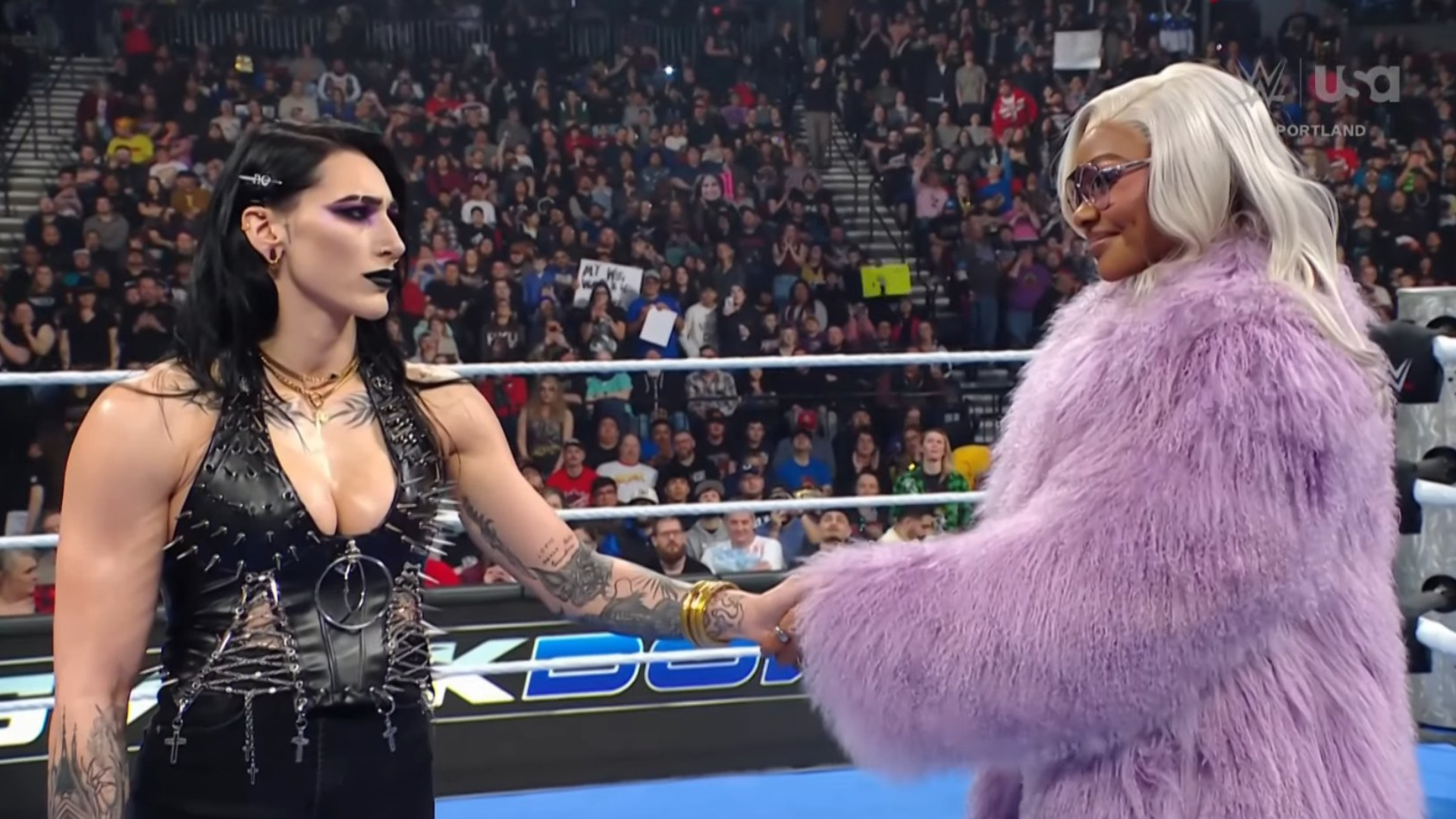
Rhea Ripley and Jade Cargill via WWE
The following content reflects my personal opinion and should be interpreted as such. Any views expressed here are solely mine and do not represent any official stance. This opinion piece is intended for entertainment and discussion purposes only, and should not be construed as factual information or professional advice. Reader discretion is advised.
There’s something slightly off about the way Rhea Ripley and Jade Cargill interact.
Not bad. Not Broken.
Just…. restrained.
A hesitation. A visual restraint—like there are things both women want to say, but won’t. A line drawn in the sand that neither has fully crossed.
And that’s where things get interesting.
Because is that restraint adding fuel to the fire? Or is it quietly cooling a rivalry that should already be burning out of control?
There is clearly a difference in energy between them. And sometimes, different energies don’t blend—they clash.
Maybe it’s differing opinions of each other.
Maybe it’s ego.
Maybe it’s hierarchy.
But what’s undeniable is this: both women carry themselves like they are the standard.
And when two people believe they are the best, tension isn’t a flaw—it’s inevitable.
Which is why this should feel bigger than it does.
Two dominant forces. Two completely different paths. One collision course over a championship. This should be one of the defining rivalries of 2026.
Instead, it feels controlled.
Packaged. Smothered.
Filtered through safe dialogue, surface-level comparisons, and “cute” phrasing that softens what should feel raw.
And that’s the problem.
Because what’s underneath all of this? Is actually dangerous.
There have been countless wrestling feuds that felt so real—so authentic—you could feel the tension through the screen. That’s what pulled you in. That’s what made you pick a side. Sometimes it was simply about connection—who you related to more.
Other times, it was something deeper.
Real tension.
The kind that doesn’t need to be manufactured because it already exists.
We’ve seen it generate undeniable results. The Rock and John Cena turned real-life friction into box office success. Charlotte Flair and Becky Lynch blurred the lines between performance and reality. And then there’s CM Punk—who, quite frankly, could turn tension with anyone into something unforgettable. Because wrestling is at its best when it feels just real enough to make you feel uncomfortable. And right now, that’s exactly what’s missing.
What WWE is doing with Rhea Ripley and Jade Cargill feels… Safe. Like they’re avoiding the very thing that could make this rivalry special. They’re dancing around the tension instead of confronting it. And in doing so, they’re stripping away the authenticity that makes people care in the first place.
And to be fair—that kind of approach isn’t without risk.
When you lean into real smoke, you’re walking a very fine line. We’ve seen it go both ways.
Charlotte Flair and Becky Lynch turned real emotion into one of the most compelling stories in modern wrestling.

Their rivalry worked because it didn’t feel scripted—it felt personal. But when that line isn’t handled carefully, it can just as easily fall apart. Moments can become awkward. Promos can miss. And instead of elevating the story, it exposes the cracks. Which is why WWE often chooses to play it safe.. until it can’t.
But in doing that, they risk something even worse—making the audience feel nothing at all. And that’s where the disconnect with Rhea and Jade becomes impossible to ignore.
Because while this feud is still taking shape, Jade publicly named Flair—not Ripley—as her ideal WrestleMania 42 opponent in an interview with Complex, calling it a ‘money-making match.’
And that’s not a small detail. Because when you’re in the middle of building a rivalry—especially one of this magnitude—the focus should feel locked in. But instead, that moment created distance. It made this feud feel less immediate. And whether intentional or not, it only adds to the sense that something here isn’t fully connecting yet.
And that’s what makes this even more frustrating. Because it’s not as if either woman is incapable of carrying something deeper.
Rhea has already proven she can anchor a feud built on emotional stakes and long-term storytelling. Her rivalry with Liv Morgan wasn’t just about dominance—it was about consequence. Rhea took Liv out of action, sidelining her for months. And when Liv returned, she didn’t come back for competition—she came back for revenge.
And she took everything.
The championship.
The power.
Even Dominik Mysterio and The Judgment Day.
It wasn’t just a feud—it was a complete unraveling of Rhea’s world.
Jade’s story with Naomi followed a different path—but landed in a very similar place. What began as a growing alliance between Jade, Naomi and Bianca Belair slowly created tension beneath the surface. Naomi, watching from the outside, wasn’t just replaced—she was being erased. And instead of confronting it head-on, she let it build.

Quietly. Strategically.
Until she struck. The attack, the deception, the eventual reveal—it turned what looked like a simple partnership story into something far more layered. And when Jade finally got her hands on Naomi, it wasn’t just about retaliation—it was about restoring order.
Neither of these stories relied on real-life tension. But they felt real. Because the emotions were clear. The motivations made sense. And the audience was given something to invest in. Which is why the current approach stands out even more. Because if both Rhea and Jade have already proven they can make people feel something deeper… then why does this feel like it’s being held at a distance?
And yet, despite all of that—despite both women proving they can carry emotionally grounded stories—there’s something else sitting beneath the surface. Something WWE has chosen not to touch. Because outside of the ring, there have already been flashes of friction.
A brief exchange online. Other names stepping in. Narratives forming—fair or not—about personality, professionalism, and position.
And whether any of it is true is almost irrelevant. Because once something like that enters the conversation, it doesn’t just disappear.
It lingers. The audience sees it. They talk about it. They build their own interpretations of it.
So when Ripley and Cargill stand across from each other on television and none of that energy is acknowledged—even indirectly—it creates a disconnect. Because the fans aren’t stupid. They can feel when something is being avoided. And in wrestling, avoidance is the quickest way to flatten something that should feel layered.
That’s where this becomes less about conflict…and more about performance. Because beyond being athletes, both of these women are also performers. They are playing characters. They are telling stories. And in any form of performance—especially one rooted in reality—discomfort isn’t something you run from.
It’s something you learn to use.
Actors are taught to sit in that discomfort. To channel it. To let it inform the character rather than suppress it. And this feels like a perfect example of that opportunity being missed.
Because there are threads here that could be pulled—carefully, intentionally, but effectively.
Questions of favoritism.
Questions of perception.
Questions of respect.
Not as accusations. But as tension.
Because whether it’s the idea that one is protected… or the perception that the other is difficult…

Those narratives already exist in the audience’s mind.
And when used correctly, that kind of tension doesn’t damage a story. It deepens it.
But that only works if there’s a foundation of control—and more importantly, respect. Because there’s a difference between blurring the lines…and losing them completely. And that’s the real question here. Not whether tension exists—because it does. But whether there’s enough mutual respect between Rhea and Jade to handle it. Because if there is, then the answer isn’t to avoid what’s already there.
It’s to lean into it—deliberately. Let them press a little closer to the truth. Let the words feel a little less rehearsed. Let the discomfort exist instead of smoothing it out. Not enough to lose control of the story. But enough to make the fans become invested…and start questioning what’s real.
And the audience can feel the difference.
Because if WWE doesn’t…then this won’t be remembered as the feud that could have been great—but the one that was never allowed to be real.






If I May Speak Candidly… Jade Cargill Doesn’t Need to be Humble – I am Megan Ambers
[…] presence, self-assurance—suddenly become points of criticism when they show up in Jade Cargill. So the question isn’t just whether Jade is “too much.” It’s why that level […]