

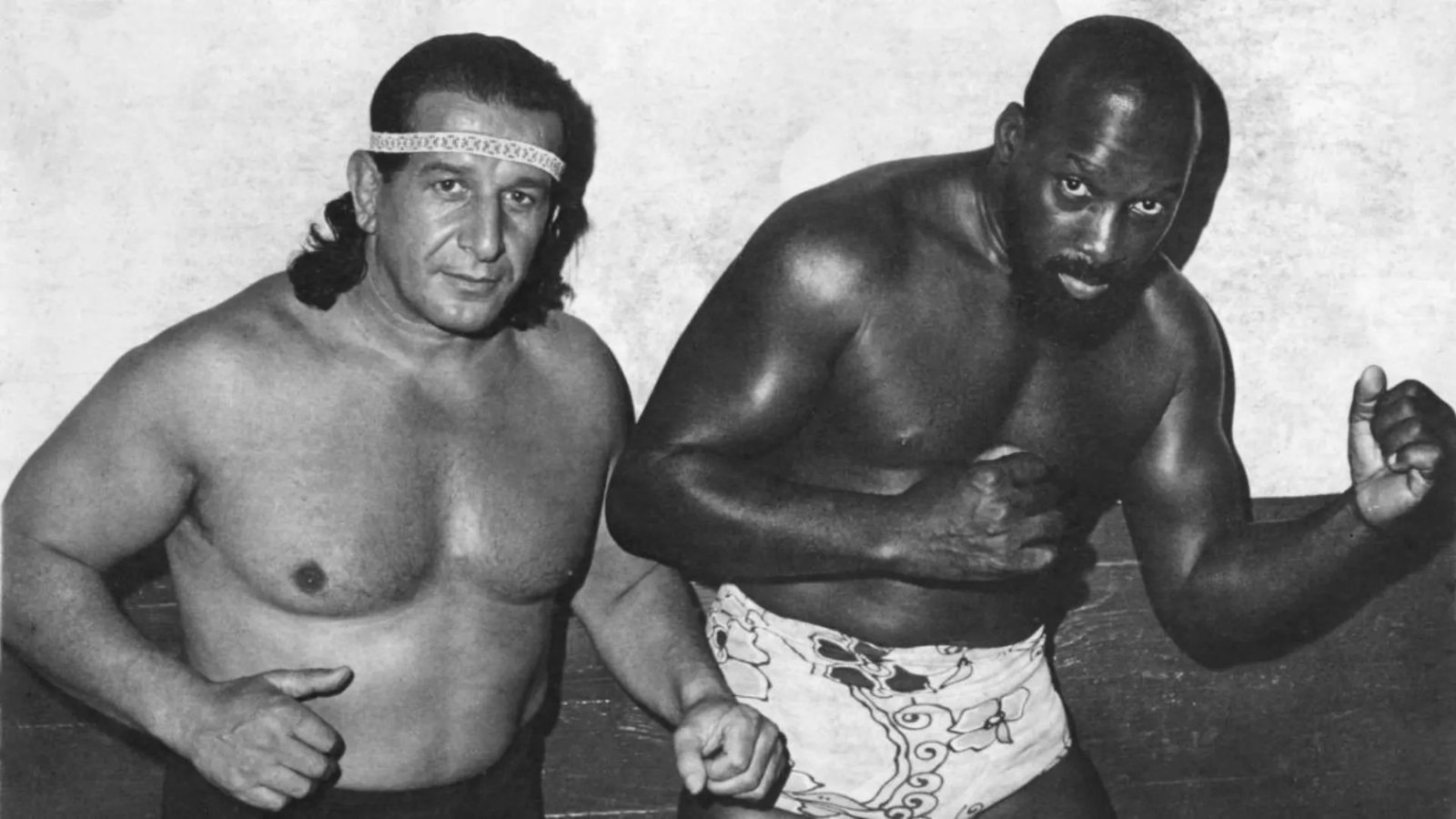
Sonny King and Chief Jay Strongbow
The following content reflects my personal opinion and should be interpreted as such. Any views expressed here are solely mine and do not represent any official stance. This opinion piece is intended for entertainment and discussion purposes only, and should not be construed as factual information or professional advice. Reader discretion is advised.
When I think about Black wrestling excellence, I don’t start with pyrotechnics or billion-dollar television deals. I start with Sonny King. Because before the industry learned how to celebrate Black greatness, Sonny King learned how to survive it.
King came up in an era when being a Black wrestler meant being boxed in — limited opportunities, limited visibility, and expectations shaped more by prejudice than potential. And yet, he broke through anyway. The more I studied his career, the clearer it became: Sonny King wasn’t simply talented. He was undeniable.
A dominant force during the territory era, King made his most significant impact in the NWA’s southern circuits, where he captured the NWA Southern Heavyweight Championship multiple times. In that era, championships weren’t props or marketing tools — they were trust. Promoters put titles on wrestlers who could draw money, command respect in the locker room, and anchor a territory. Sonny King did all three (National Wrestling Alliance, 1970s–1980s).
In 1972, King etched his name into history by capturing the WWWF Tag Team Championship alongside Chief Jay Strongbow, becoming the first Black wrestler in WWWF (soon WWF-WWE) to obtain gold. That reign wasn’t a throwaway title or a flavor-of-the-month spotlight. It was a real moment of championship gold in one of the most influential promotions of the era (WWWF, 1972). For a Black wrestler in the early ’70s, that achievement was a heavyweight statement.
But what truly defines Sonny King’s legacy isn’t just the title belts — it’s what he represented. In an industry still wrestling with its own prejudices, King carried himself with a quiet, undeniable professionalism. He didn’t just break through barriers; he walked beside them with integrity. His name still comes up in conversations among historians and old-school fans as one of the early Black performers who proved that excellence doesn’t need validation — it demands it.
Later in life, King stepped away from the spotlight and into a quieter chapter, running his own business in Florida. What he didn’t step away from was his influence. To many who watched him in his prime, King remains a template: work ethic first, character next, legacy last — but everlasting.
Sonny King represents the foundation — the uncomfortable truth that Black wrestlers have always been capable of carrying this business, even when the business refused to carry them back. Every Black champion who followed, every barrier broken, every moment once deemed “impossible” stands on the shoulders of pioneers like him.
Sonny King did not simply exist in Black wrestling history — he helped build its foundation. Every Black champion who followed stands on the shoulders of pioneers like him.












Leave a Reply